Thursday, October 3, 2013

So, what's so bad about climate change, anyway?

I mean, most folks love summer, right?

Back in July, Climate Progress ran an interesting top ten list of the things climate change is making worse RIGHT NOW.

In August, Science published a study on climate change impacts on global food security. So - climate change is powering a potential return to mass food insecurity - and we aren't even yet close to fixing food insecurity for the first time so we can "return" to it!

Here's an excellent resource from National Geographic on the sometimes surprising effects of climate change - it's been up for awhile, but is very worth revisiting.

Today, the Guardian reports on how climate change is sending the health of our oceans "spiraling downward faster than previously thought." Oceans = seafood, for one thing. Also immense food webs that power life across the planet. You know - little things like that.

Here's a picture of the view from the approach to the Deception Pass Bridge. It's a lovely picture. Can't say how long Deception Pass will look like this.


Monday, September 30, 2013

Greenpeace's Direct Action Page Archived!

Searching for opportunities for direct action on climate change, I cruised over to Greenpeace's site to see if they were doing anything.

Here's what I found.


Obviously this doesn't mean they've thrown in the towel - or that the links ("Become a Cyberactivist" and others that I didn't get in my screen grab - aren't live. But to see "This page has been archived, and may no longer be up to date" was a little disconcerting, to say the least.

If ever there was a time for direct action - Greenpeace stylee - that time is NOW.


Idea Time!

(Note - title to be exclaimed like "Hammer Time!")

Micro dwellings.  Here's a slideshow I grabbed from the Huffington Post today. Micro apartments from the Old Days in Tokyo.

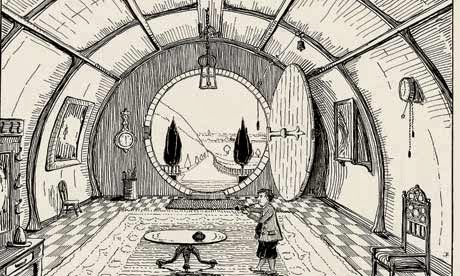
Tolkien's original drawing of Bag End - now maybe if we could all become Hobbit-sized?


So that's one place to start thinking. Down-size our dwellings, which would down-size the amount of energy required to construct, furnish, and maintain them. Tax the hell out of houses larger than a certain square footage per occupant, and plow the dollars raised back into other green initiatives.

The EPA says that electricity production was responsible for about a third of greenhouse gas emissions in 2011. Smaller houses would take less electricity to light and heat, wouldn't they? The EPA further notes that over 70% of our electricity comes from burning fossil fuels - and we know that burning fossil fuels contributes to global climate change.

Surprisingly, that third of greenhouse gas emissions from electricity production is MORE than the 28% of 2011 greenhouse gas emissions from transportation! However, since over 90% of the fuel used for transportation is petroleum-based, maybe the two are equivalent? (I need a refresher course in basic math.)

Bonus link - to the Tumbleweed Tiny Home Company's site, which features some adorable small houses that start at a decidedly Hobbity 73 square feet!

Friday, September 27, 2013

And oh yeah... to add insult to injury...

HOTTEST AUGUST... ever.

If NOAA says it was, it was.  Good thing there is science backing up my hysterical personal supposition that I spent this past August doing the Most. Face. Sweating. EVER.


IPCC Report - "Climate Change 2013: The Physical Science Basis"


Can't get the entire report to download, so am reading the "Summary forPolicymakers."  Hah!  "Look, Ma - I'm a policymaker!"

Wish I was.  I know a few policies I'd put in place, sharpish. But I digress.

Check out this bit of the summary report (italics in the original):


"Human influence has been detected in warming of the atmosphere and the ocean, in changes in the global water cycle, in reductions in snow and ice, in global mean sea level rise, and in changes in some climate extremes. This evidence for human influence has grown since AR4. It is extremely likely that human influence has been the dominant cause of the observed warming since the mid-20th century."

And yes, I am suppressing my urge to roll my eyes and exclaim "Duh!"

Here's something else I am sure you didn't already know (snark intentional): 


"Continued emissions of greenhouse gases will cause further warming and changes in all components of the climate system. Limiting climate change will require substantial and sustained reductions of greenhouse gas emissions."

And then (again, italics in original)...

"Global surface temperature change for the end of the 21st century is likely to exceed 1.5°C relative to 1850 to 1900 for all RCP scenarios except RCP2.6. It is likely to exceed 2°C for RCP6.0 and RCP8.5, and more likely than not to exceed 2°C for RCP4.5. Warming will continue beyond 2100 under all RCP scenarios except RCP2.6. Warming will continue to exhibit interannual-to-decadal variability and will not be regionally uniform." 

And then we get to sea level (italics in original)...

"Global mean sea level will continue to rise during the 21st century (see Figure SPM.9). Under all RCP scenarios the rate of sea level rise will very likely exceed that observed during 1971–2010 due to increased ocean warming and increased loss of mass from glaciers and ice sheets." 

And then, in section E.8 - Climate Stabilization, Climate Change Commitment and Irreversibility, we get the nail in the coffin:

“A large fraction of anthropogenic climate change resulting from CO2 emissions is irreversible on a multi-century to millennial time scale, except in the case of a large net removal of CO2 from the atmosphere over a sustained period. Surface temperatures will remain approximately constant at elevated levels for many centuries after a complete cessation of net anthropogenic CO2 emissions. Due to the long time scales of heat transfer from the ocean surface to depth, ocean warming will continue for centuries. Depending on the scenario, about 15 to 40% of emitted CO2 will remain in the atmosphere longer than 1,000 years.”

SO NOW WHAT???!!!!

Well one thing is for certain, this is going to take massive action - immediately.  Governmental firepower needs to be thrown behind a scientific solution or solutions.

Geoengineering methods, like Solar Radiation Management (SRM) and Carbon Dioxide Removal (CDR) are mentioned at the very end of the report, but the IPCC goes on to say that there is insufficient knowledge about any of these technologies to predict what they would or could do – and warns of limitations and frightening sounding “side” effects.

But what, pray tell, is the alternative to action?

Drowning in toxic swill - burning in wildfires - enduring devastating hurricanes - succumbing to myriad exotic mosquito-borne diseases?  And not "in the future," but in the next few weeks for some?

Ideas?  I'm feeling a little freaked out, here, myself. 

Thursday, September 26, 2013

Shouting into the void?

There's a GREAT piece over at New Scientist today (check it out here) that calls for a new way to communicate about climate change.

Courtesy North Central Community Association
They're right.  Here's a snippet:

"One of the most striking findings is that concern about climate change is not only, or even mostly, a product of how much people know about science. Increased knowledge tends to harden existing opinions (Nature Climate Change, vol 2, p 732).


These findings, and many more, are increasingly available to campaigners and science communicators, but it is not clear that lessons are being learned. In particular, there is a great deal of resistance towards the idea that communicating climate change requires more than explaining the science.


The IPCC report, due out on 27 September, will provide communicators with plenty of factual ammunition. It will inevitably be attacked by climate deniers. In response, rebuttals, debunkings and counter-arguments will pour forth, as fighting denial has become a cottage industry in itself.

None of it will make any real difference. This is for the simple reason that the argument is not really about the science; it is about politics and values."  (Emphasis mine.)

I continue to believe that it's also about pocketbooks and personal impacts. If people understand just how THEY will be PERSONALLY impacted - not "the planet," and not "in the future" - they might just listen up. 

The data bores people. The crystal ball gazing irritates people. Only by telling folks where the rubber will meet the road and sharing the ways this will be seriously screwing with them in very short order, can we hope to get a response that will push the political needle anywhere near getting us a solution.

And that needs to happen fast. In fact, not fast, but yesterday. Anyone have any bright ideas?  

Wednesday, September 25, 2013

Danger from the deep

It's funny how you know something passively but don't *realize* it actively sometimes, isn't it?  I know that if warm water runs UNDERNEATH ice, it will melt the ice from below, but it never occurred to me - never HIT me - that that would apply to the polar ice sheets.

Stupid, really.  But there it is.  I've been thinking of atmospheric warming as how ice melts - but in fact, there's the additional problem of warmer-than-normal water flowing beneath them and adding to the rate of melt!

Here's a link to NASA's Global Climate Change page where they address the issue - with video!

We're meeeelllllltingggg!