Showing posts with label climate. Show all posts

Wednesday, September 2, 2020

I cannot fight...

America: September 2020. Chaotic, criminal mishegaas in the White House. Wilding White Nationalists in the streets. Furious, righteous protests met with tear gas, rubber bullets, and police brutality. A pandemic rages. The real economy – the economy of people struggling to make ends meet – is melting down, while the stock market rises higher and higher, bringing unimaginable riches to a ridiculously tiny slice of the population. California is ravaged by wildfires. Texas and Louisiana are pummeled by a ferocious hurricane that was the strongest to make landfall in the Pelican State in 160 years.

I am a proud resister and progressive, and a lifetime registered Democrat. As a Little, I accompanied my parents to demonstrations. In grade school, I proudly wore an “I was planned” button, and sported a red armband each May Day. In high school, to the derision of my peers, I publicly supported President Carter. In college I joined Greenpeace and marched against nuclear power and for social justice issues.

For the last five years my issue of choice – the issue on which I spend 75% of my time and money – has been climate change. In these parlous times, and particularly since Trump was “elected” to office, some have challenged me on my focus, and accused me of abandoning “more pressing” issues, as if climate change were not THE MOST PRESSING ISSUE of our time.

Think that only the last two sentences in the opening paragraph are related to climate change? Feel that someone who prioritizes climate action has abandoned their work on the other issues near and dear to progressive hearts? Well, that’s off base. Because it is all connected.

This year’s long hot summer of socially distanced protests have been urgent, tumultuous (though 99% peaceful), revolutionary and potentially world-shattering. The demonstrators are lancing a 400 year old boil and not letting the complacent among us look away. You want American heroes? I think the BLM and social justice warriors organizing and demonstrating and making their voices heard are heroes. But remember that among the many and cruel racial disparities in the United States they are protesting are housing, food security and healthcare. Climate change intersects with each of these in ways that put POC at a distinct disadvantage. I cannot fight for human rights and racial equality without fighting against climate change.

Kamala Harris is the nominee for VP. We didn’t manage to elect a woman last time – maybe this time, we’ll vote a woman into the #2 spot. In the meantime, it’s important to note that women will be adversely and disproportionately affected by the changing climate. For example, the widespread drought and crop disruptions that climate change will bring will destabilize our food supply, disproportionately affecting women, for whom food insecurity is a pressing problem. I cannot fight for women without fighting against climate change.

Unions are under relentless attack from the right. Without unions, we the people lose most of our power to demand that we be paid and treated fairly. Even for non-union workers, we must have an adequate minimum wage, that families can actually LIVE ON. I am 100% for a $15/hour minimum wage – or more! – and we are going to need it if folks are shelling out to re-re-re-re-build after the latest hurricane, flash flood, or wildfire. I cannot fight for working people without fighting against climate change.

Poverty is an intractable problem in America: about 12% of us (that is 36,460,000 people!!!) currently live in poverty. While the well-off will deal with the impacts of climate change where they live by buying what they need to survive, or will simply move to more amenable places out of the path of hurricanes or wildfires, poor people will not. They will be left behind in crumbling communities that are in the path of the natural disasters engendered by a warming atmosphere. I cannot fight for poor people without fighting against climate change.

Climate change is the ur-issue of our time. It’s the monster in the closet that has already devoured your neighbors and is just waiting to pounce on you. It’s the top! It’s the Colosseum – it’s the top! It’s the Louvre Museum – it’s a melody from a symphony by Strauss! Well, you get it. It will impact everything. It will change everything. It cannot be ignored, and it should not be fobbed off as “less important” because the link to something more “front of mind” and in the headlines isn’t immediately apparent.

And it is most definitely linked to the upcoming election in November.

We have already lost 4 years of potential government action under Trump. Imagine another four years – and remember: emissions are still going up.

#HairOnFirePeople

Saturday, August 22, 2020

Ruminations from June 2019 (the Before Time)


I posted this on the DailyKos over a year ago. The observations are still relevant - because we are STILL NOT DOING ENOUGH about climate change.

Well, of course we're not - that ignoramus and his wrecking crew administration don't "believe" in climate change. Are you planning to vote in November? Are you voting for Joe Biden? If not, you are part of the problem.

Seattle’s Summers Are All Effed Up, Or, The Dizzying Speed at Which Hell Becomes the New Normal.

My husband and I live in Seattle. Have done for almost 20 years. We got here right after 9/11, in which we were both tangentially involved (long story).

Since moving, we’ve become “stuck.” We’re here because we’re here at this point. 

It’s partially inertia – partially the “golden handcuffs” of excellent jobs with the state – partially the fact that we’ve made friends and nested – but it’s also partially because of the glorious beauty of Washington State.

A majestic range of mountains – the Olympics to the west and the Cascades to the east – rises up like a guardian on either side of the Puget Sound. Looking south to the implausibly majestic bulk of Mount Rainier it’s easy to understand why some indigenous people worshiped her as a god.

After only a short drive from downtown you can choose to hike through deep forests, fish in a brilliant turquoise lake, or kayak across the shimmering teal and emerald waters of Deception Pass.

On a ferry ride across Puget Sound you’ll see cormorants, guillemots, and gulls. Look down over the railing to catch a glimpse of a sea otter, and if you’re very lucky, a pod of Orcas will appear on the horizon, a shimmer of water on broad backs and jutting dorsal fins.

An hour north of town the Skagit Valley beckons, with its seaside towns, broad swathes of excellent farmland, tulips and daffodils, and amazing farm stands.

On the shores of Hood Canal the oysters and clams are just a short scratch down in the sand. Bring a garden claw and a pocket knife. Dig for 15 minutes, then feast on fresh, delicate, briny oysters that will make your toes curl with delight.

Even just trudging around bang-in-the-city-center Green Lake I can feast my eyes on magnificent conifers and see myriad colorful ducks, bald eagles, and spidery, stalking herons.

In short – it’s glorious. The weather is glorious, too.

I know – I know. Everyone says it rains a lot. Not so much. Washington State is only the 29th rainiest state in the union. Hawaii is number one, and even New York gets more rain.

We do get low gray skies and soft drizzle in the fall and winter. It’s nice. It’s not torrential. It’s good for your skin! But summers are mostly clear, and they are – or they were – utterly GLORIOUS.

It never really gets all that hot. Temps stay in the low-to-mid seventies. Lambent blue skies offer views straight up into Heaven. Everything is moist and green and lush, like a salad on steroids. In fact, much of the Pacific Northwest is a temperate rainforest!

The ecosystem of Pacific temperate rain forests is so productive that the biomass on the best sites is at least four times greater than that of any comparable area in the tropics. In sheer mass of living and decaying material - trees, mosses, shrubs, and soil - these forests are more massive than any other ecosystem on the planet. In part, this is due to the rarity of fire. Unlike drier forests, which burn periodically, temperate rain forests are naturally subject to only small-scale disturbances, such as blow-downs and avalanches.

Well, no longer.

Three summers ago, in 2017, a dear friend of mine journeyed to Seattle on the middle leg of a three-city “where should I retire?” tour. I took her on a ferry ride to Bainbridge Island. I wanted to cry. As we chugged away from the dock, the skyline receded into a grimy haze. Within ten minutes the Space Needle was barely visible. A grim shroud enveloped Rainier to the south: it was as if she didn’t exist. My friend tried to be polite about the not-all-that-dazzling scenery, and all I could think of was Mordor.

That was the first summer of wildfires on an epic scale. Records were set. Terrifying, horrifying records for heat and aridity – two things for which the Puget Sound has not historically been known.

On September 5, ash from the Central Washington fires fell "like snow" on Seattle and as far west as Grays Harbor County, which borders the Pacific Ocean.

Again in 2018, the wildfires raged and roared. Governor Inslee declared a state of emergency in July. In July and August the city smelled like a camp fire, and the skies were dull and gray.

The Boylston Fire started on July 19 again shut down I-90 east of Ellensburg for 24 hours. It burned 80,000 acres, mostly on the Yakima Training Center, caused level three "leave now" evacuations, and destroyed five buildings while being fought by three fixed-wing aircraft and two helicopters. Military personnel and equipment to fight the fire were sent from Fairchild Air Force Base in Spokane and Joint Base Lewis-McChord in the Puget Sound Area.[23][24][25] The smoke caused "unhealthy" air conditions in Spokane on July 20.

The mellow drizzle of autumn was a more than usually welcome relief.

That was two summers in a row. Just two.

It’s June now and we’re on the slide into summer. About a month ago, I saw a TV spot for a local heating and air conditioning company. The voice over brought me up by the short hairs.

The reference to the “smoky air of summer” was dropped in so matter-of-factly, so casually, that at first I didn’t think I’d heard correctly. But I had. To at least one big Seattle company, the “smoky air of summer” needs no explanation. That’s just how summers are around here – buy our superior air conditioners!

THE SMOKY AIR OF SUMMER IS NOT A NORMAL THING. The smoky air of summer is something that did not exist until recently. Summers in the Puget Sound were cool, breezy, lovely. There’d be a few hot days in August when I’d sweat and curse, but never more than a week or two. Never a stretch of days when the forests were engulfed in raging flames and the air was choked thick with smoke. Never.

And now, it seems to be the “new normal.”

“We’re headed into summer, folks! Time to get out your asthma inhalers and make sure your air purification system is working! Gonna be some wildfires!”

We humans get used to things really quickly. We adapt. We don’t have particularly long memories, and we forget that what we thought was normal is now a memory, getting ever more distant as the years march on.

But we have to take notice. We have to remember. We have to pay attention and not allow ourselves to slide into a non-reactive state of torpor. Things change — things fall apart — really really fast. It is starting to be TOO LATE.

Wildfires are increasing as the climate changes. That’s a fact. That’s something we know.

Now what the ACTUAL HELL are we going to do about it?

My very first diary on this site was posted May 21, 2015. Allow me to quote myself:

It was late 2012, on a week day, about 5:00am. I’d just sent my husband out the door with his lunch and was brewing myself a cup of tea to enjoy in front of the odious "Morning Joe," when he called to share something horrifying he’d just heard on NPR.

They were reporting that at a recent climate change conference, some leading scientists had stated that 2020 is the LAST YEAR we humans can do anything to reverse the effects of climate change. At that point, said my husband a little breathlessly, everyone on the planet could stop driving cars and it WOULD NOT MATTER. We’d already be toast. Almost literally.

It’s 2019.

Carbon dioxide emissions are going up.

Hair. On. Fucking. FIRE.


Thursday, September 29, 2016

The Last Big Push

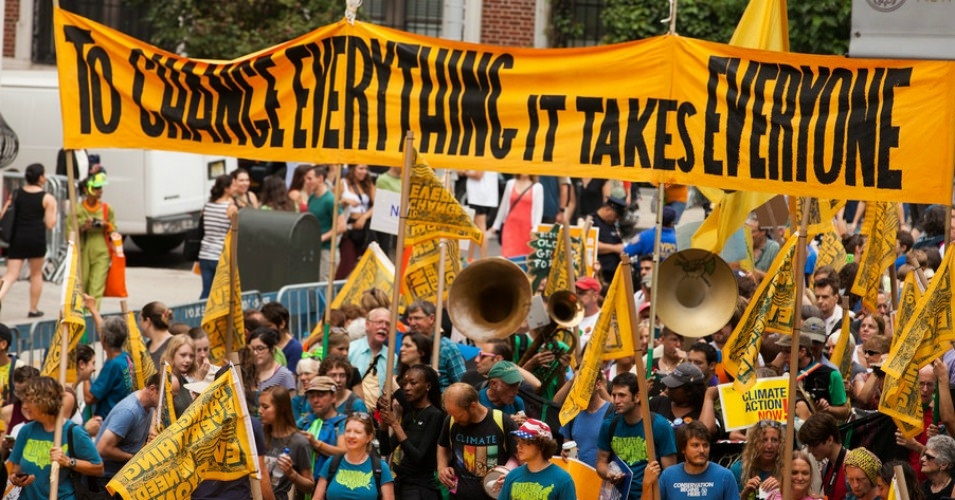
In calendar 2017, I suggest we pivot to climate together. What am I rambling about? I'm asking that all of the social, environmental, and climate justice organizations that came together for the People's Climate March in September of 2014 come back together for ALL of 2017, and spend at least 50% of their time and treasure that year on climate change:

  • Outreach
  • Action
  • Lobbying
  • Education
  • Advertising
  • Web presence
  • Social media

This is the last year. This must be the big push. Let's #PivotToClimate!

If we act fast, we may be able to seize and take advantage of one of those rare windows of opportunity that comes at the exactly right time - when we are close enough to disaster that we can see it looming up on the horizon, and yet have JUST enough time to grab the wheel and yank it around, narrowly avoiding what might otherwise have been inevitable.

In the April 2015issue of Scientific American, this appeared: "Greenpeace, a leading environmental advocacy group, says we have until around 2020 to significantly cut back on greenhouse gas output around the world—to the tune of a five percent annual reduction in emissions overall—if we are to avoid so-called “runaway” climate change.

This was when, as the article also noted,
"Currently the atmospheric concentration of CO2 (the leading greenhouse gas) is approximately 398.55 parts per million (ppm). "

And
"According to the National Oceanic and Atmospheric Administration (NOAA), the federal scientific agency tasked with monitoring the health of our oceans and atmosphere, the current average annual rate of increase of 1.92 ppm means we could reach the point of no return by 2042."

In September, we crossed the threshold of 400ppm of CO2 in the atmosphere.


To quote from a recent piece on ThinkProgress:
"In the late 2000s, climate scientist James Hansen argued that the world needed to stay below 350 parts per million to avoid the worst impacts of climate change (his warning is what gave 350.org, the global climate activism group, its name). Three years ago, Earth’s atmospheric carbon dioxide levels first exceeded 400 parts per million, but those levels quickly dipped back below the threshold, as atmospheric carbon dioxide waxes and wanes with the seasons.

Which is why the fact that atmospheric carbon dioxide is still above 400 parts per million at the end of September is a worrying fact: September is usually the time when concentrations are at their lowest, as trees in the Northern Hemisphere have grown all summer, sucking carbon out of the atmosphere. In a blog post, Ralph Keeling, current head of the Scripps carbon dioxide measurement program and son of Charles Keeling, wrote that it is “almost impossible” that CO2 levels will drop below 400 in October.

“Concentrations will probably hover around 401 ppm over the next month as we sit near the annual low point,” he wrote. “Brief excursions towards lower values are still possible but it already seems safe to conclude that we won’t be seeing a monthly value below 400 ppm [parts per million] this year — or ever again for the indefinite future.”"

The first year of the new Clinton Administration will be the most propitious time - the time with the most potential for radical change - that we will have until… well, until it is likely too late.


The energy from pulling off a win could propel the new administration to take bold, aggressive action on climate change during Hillary Clinton's first year in office - especially if all of the players from the 2014 People's Climate March get back together (we're getting the band back together!) and focus her attention on the people's will.

If we act fast, we may be able to seize and take advantage of one of those rare windows of opportunity that comes at the exactly right time - when we are close enough to disaster that we can see it looming up on the horizon, and yet have JUST enough time to grab the wheel and yank it around, narrowly avoiding what might otherwise have been inevitable. Let's PIVOT TO CLIMATE - TOGETHER.

#PivotToClimate - #StrongerTogether